What You Don’t Have to Build
Most buildings add systems. This one removes them.
Most high-performance buildings are framed as an exercise in addition: more equipment, more controls, more coordination, and more layers of mechanical infrastructure.Termobuild takes a different path by activating the concrete structure already in the building to provide heating, cooling, ventilation, and thermal energy storage through one integrated approach.
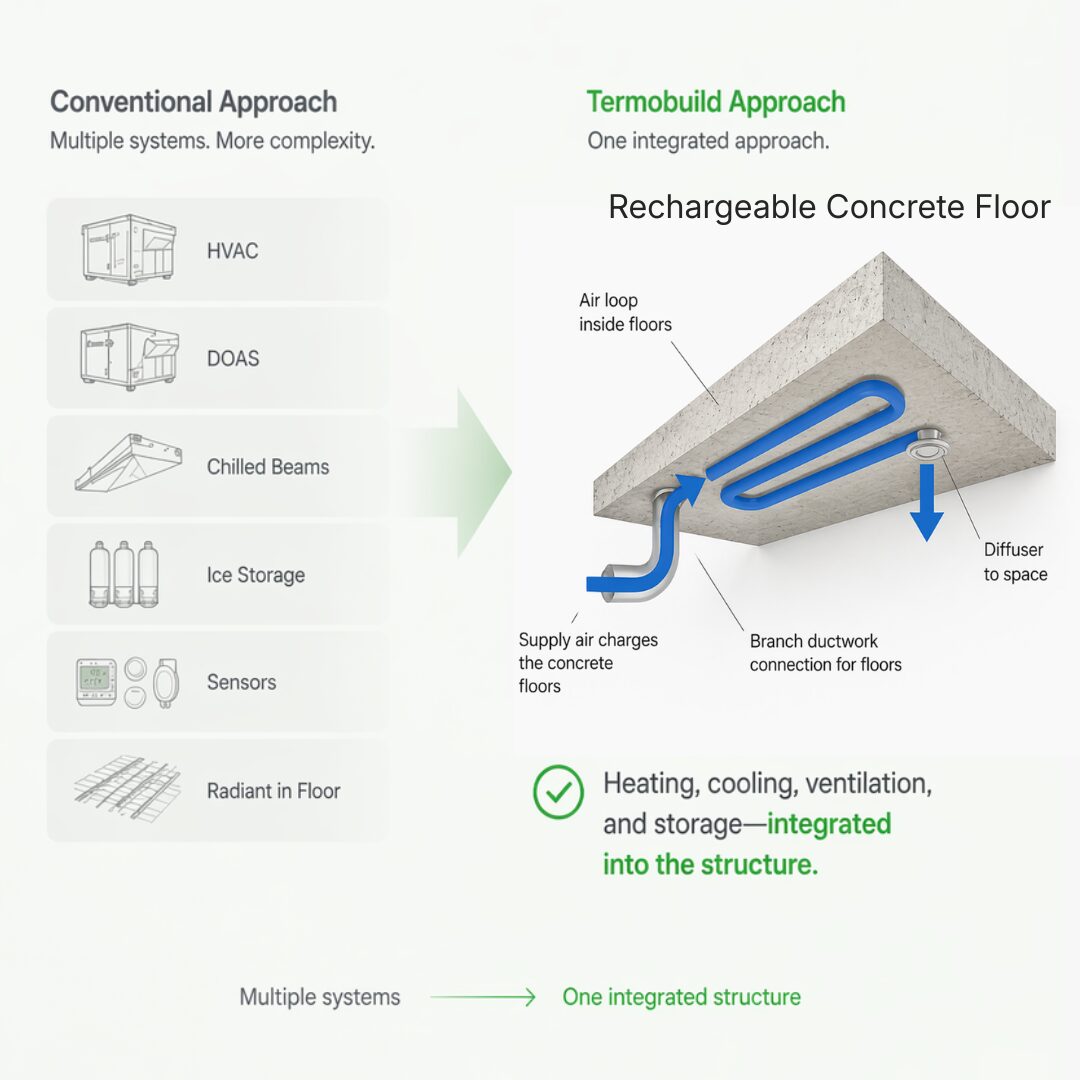
Most building systems are designed by accumulation
When performance goals rise, conventional design often responds by stacking on more: larger HVAC dependence, more coordination, more specialty systems, and more operational burden. The result is often a building that performs through added complexity rather than through better use of the structure already in the project.
More Equipment
Conventional high-performance strategies often depend on adding more hardware rather than activating building mass already paid for.
More Coordination
More systems mean more interfaces, more field coordination, and more opportunities for cost growth and design friction.
More Operational Burden
More controls, more software, and more moving parts can increase maintenance demands and long-term complexity for owners and operators.
The industry default is simple: add more systems.This approach does the opposite.
Termobuild turns the concrete structure into an active thermal asset instead of leaving that mass dormant.
What this approach can reduce or eliminate
This is not about layering a new gadget onto a conventional design. It is about simplifying the mechanical strategy by shifting more of the work into the structure itself.
Conventional Path
- Greater dependence on active HVAC cycling to maintain comfort
- More perimeter ducting and layered distribution infrastructure
- More ceiling-space competition and mechanical congestion
- Higher reliance on advanced add-on efficiency measures
- More controls, sensors, software, and specialized oversight
- More parts, more maintenance touchpoints, more mechanical burden
Termobuild Path
- Heating, cooling, ventilation, and storage integrated through the structure
- Reduced mechanical size and lower dependence on layered systems
- Potential to reduce or eliminate elements such as perimeter ducting, drop ceilings, and added system layers in the right project conditions
- Fewer added systems competing for budget and coordination
- No separate thermal battery, tank, or parallel storage infrastructure required
- Simpler building performance with fewer operational burdens
Why this matters financially
Owners do not benefit only from lower operating costs. They benefit from avoiding infrastructure they may no longer need to buy, coordinate, maintain, and replace over the life of the building. See how owners can evaluate the building strategy before scope is finalized.
Based on historical project performance data:
Depending on project type and design conditions, Termobuild may also be cost neutral at first cost while still improving building performance and reducing mechanical complexity, operating burden, and lifecycle cost exposure.
Cost avoidance is different from cost transfer
Some high-performance buildings reach their targets by introducing added systems that shift complexity into installation, operations, and maintenance. This can include dedicated thermal storage infrastructure including ice storage and centralized thermal storage tanks.Termobuild creates value differently: by reducing the amount of mechanical infrastructure the building depends on in the first place by shifting heating and cooling loads into the structure itself.
Less to Install
Fewer system layers can mean less field coordination, less congestion, and a cleaner design path.
Less to Maintain
Reducing equipment, controls burden, and dependency on complex add-ons can lower long-term operational friction over the life of the building.
More Budget Flexibility
When unnecessary system layers are avoided, capital can stay available for priorities that improve project value elsewhere.
How it works in practical terms
Instead of treating concrete only as structure, Termobuild uses the slab as an active medium for storing and releasing thermal energy. Air moves through the floor system at strategic times to capture favorable temperature conditions and help maintain comfort with less active mechanical effort during occupied hours.
Charge the Structure
Use favorable outdoor conditions during off-peak periods to store cooling or heating potential in the slab.
Use Stored Energy
The building mass helps stabilize indoor conditions during occupied hours, reducing the need for constant HVAC response.
Reduce Mechanical Burden
With the structure doing more of the work, the project can rely less on oversized or layered mechanical strategies.
This is especially relevant when owners want more from the same building
Schools, institutional buildings, commercial projects, and other large-floorplate buildings often already contain the structural mass. The question is whether that mass remains passive — or starts working for the project.
Better Comfort Stability
Thermal storage in the structure helps smooth swings rather than reacting late with more active equipment.See how this delivers radiant comfort and fresh-air ventilation.
Fresh-Air-Oriented Design
Ventilation is integrated into the overall strategy, helping deliver comfort and fresh air without relying on more separate system layers.
Simpler High Performance
Instead of asking the building to perform better by becoming more complicated, this approach asks the structure to do more.
See what your project may not need to build — before you design it in
If you are comparing conventional mechanical design against an integrated structural thermal storage approach, Termobuild can help identify where equipment, mechanical burden, and lifecycle cost may be reduced.