Built-In Thermal Resilience Starts Before a Disruption
Termobuild actively manages heating and cooling stored in the building’s concrete structure. That stored thermal capacity can help moderate indoor temperature changes when HVAC operation is reduced or interrupted—subject to building conditions, system design, and available power.
What Happens to Indoor Conditions When HVAC Is Interrupted?
All buildings experience temperature drift when heating or cooling is interrupted. The rate depends on insulation, outdoor weather, solar gains, occupancy, ventilation, and the thermal capacity available within the building.
Power Outages
Extreme weather and grid disruptions can leave buildings without the active systems they rely on most.
HVAC Dependency
Mechanical equipment and controls are important to comfort, but a disruption can limit their ability to condition or ventilate occupied spaces.
Operational Risk
Indoor temperatures, air quality, and safe operating conditions must be evaluated separately during an outage.
The Termobuild Difference
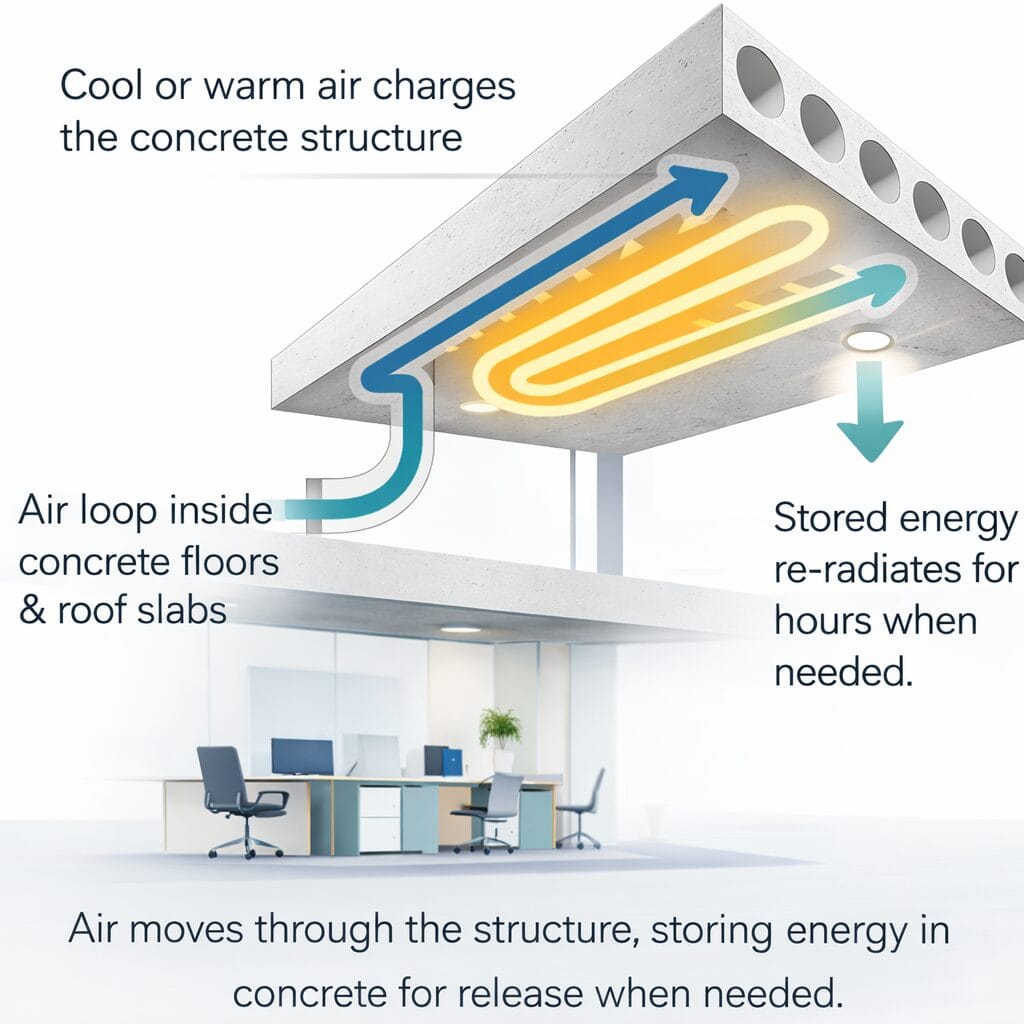
Termobuild integrates engineered airflow pathways and HVAC controls with concrete thermal mass. Rather than relying only on passive heat absorption, the system can deliberately charge the structure ahead of expected demand and use its stored capacity to help moderate temperature changes.
The Building Becomes the Energy Reserve
Concrete acts as a distributed thermal reserve. Its charging and discharge are coordinated with the building’s HVAC operation and control strategy.
Thermal Buffering Without Dedicated Tanks
Structural storage can supplement a resilience strategy without dedicated thermal storage tanks. HVAC equipment, fans, controls, and appropriate backup systems remain important.
Resilience Starts Before the Disruption
Active structural thermal energy storage creates opportunities to manage the building’s thermal reserve ahead of changing conditions—not simply react to them.
1. Charge
Condition the concrete structure through engineered airflow when outdoor conditions, equipment operation, or energy timing are favorable.
2. Manage
Coordinate stored thermal capacity with HVAC controls, occupancy needs, and comfort limits. Control capability depends on the specific project design.
3. Buffer
If mechanical conditioning is interrupted, previously stored heating or cooling may help slow indoor temperature changes. It does not generate electricity or guarantee safe indoor conditions.
4. Recover
When systems return, normal HVAC and control operation can restore the desired thermal state. Recovery time and demand must be evaluated during design.
Learn how active structural storage differs from passive thermal mass and dedicated ice storage: Thermal Storage Without Dedicated Tanks.
What Happens During a Disruption?
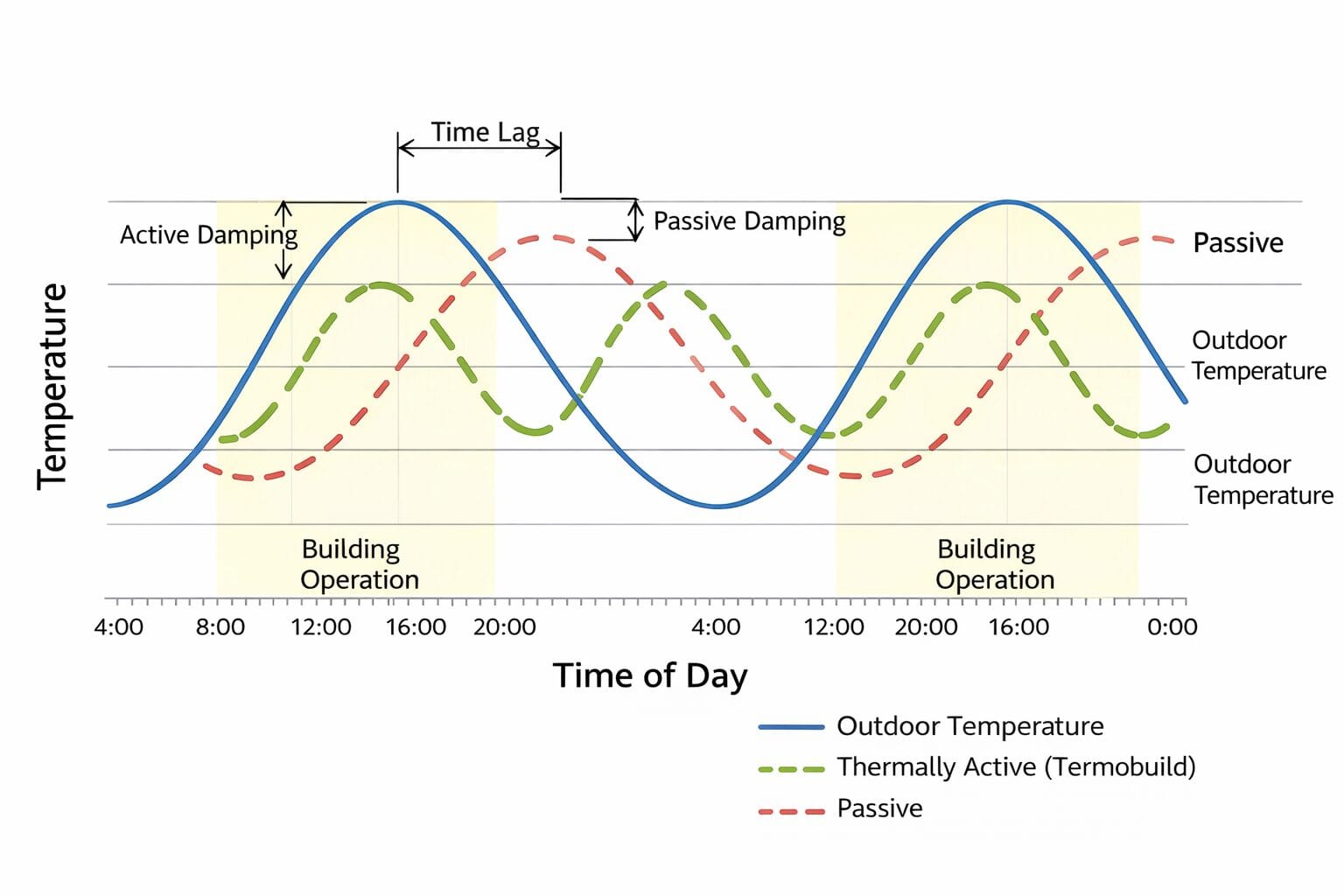
Stored thermal capacity may slow indoor temperature drift when active heating or cooling is unavailable. Actual resilience performance requires project-specific modeling or measurement.
Conventional Building
- Indoor conditions depend on the envelope, internal gains, and HVAC operation
- Temperature drift depends on weather and building design
- Duration within acceptable temperature limits must be assessed
- No actively managed structural reserve assumed
Termobuild Building
- Stored heating or cooling may continue to buffer temperature changes
- Potentially slower temperature drift under suitable conditions
- Fresh-air delivery requires functioning ventilation equipment and power
- No guaranteed outage duration or habitable-condition claim
Built Projects and Engineering Evidence
Installed projects demonstrate how structural thermal mass can be integrated with ventilation and HVAC. They do not, by themselves, establish a specific number of hours of safe operation during a power outage.
Sheridan College — Brampton, Ontario
The Canadian Precast Prestressed Concrete Institute documented the use of a TermoDeck system in the Centre for Manufacturing and Design Technologies. Its account describes air passing through hollow-core concrete slabs to store and distribute heating and cooling.
Resilience Performance Must Be Verified
For each project, evaluate temperature drift, storage state before a disruption, weather, ventilation requirements, fan and control power, and the recovery period. Performance should be established through simulation, commissioning, or measured operating data.
Why This Matters to Owners, Schools, and Institutional Projects
Resilience is no longer a “nice to have.” It affects continuity of operations, asset value, occupant safety, and long-term building performance.
Business Continuity
Thermal buffering may support continuity planning, but operating decisions must still account for power, ventilation, occupant safety, and critical equipment.
Future-Ready Assets
Thermal capacity and controllable demand can be considered alongside envelope performance, emergency power, and operational plans.
One Strategy, Multiple Gains
A coordinated design can evaluate capital and operating economics alongside thermal flexibility and resilience, with outcomes verified for each project.
More Than Energy Savings
Termobuild is not just about lowering energy use. It is about using the structure already in the building to improve comfort, reduce mechanical burden, shift energy demand, and create a more resilient built environment.
What the Structure Can Do
- Store heating and cooling energy
- Help stabilize indoor temperatures
- Reduce daytime peak demand
- Integrate fresh-air delivery during normal powered operation
- Potentially slow indoor temperature drift during disruptions
What This Can Replace or Reduce
- Some mechanical capacity, where supported by load calculations
- Reliance on separate dedicated thermal storage assets
- The rate of indoor temperature change during some disruptions
- Underused structural thermal capacity
See What Built-In Resilience Could Mean for Your Project
If you are evaluating long-term building value, energy performance, capital cost, and operational resilience, Termobuild can help you evaluate how active structural thermal storage may affect demand, comfort, and temperature drift during interruptions compared with a conventional design.