The future of Rechargeable Buildings is already in the structure.
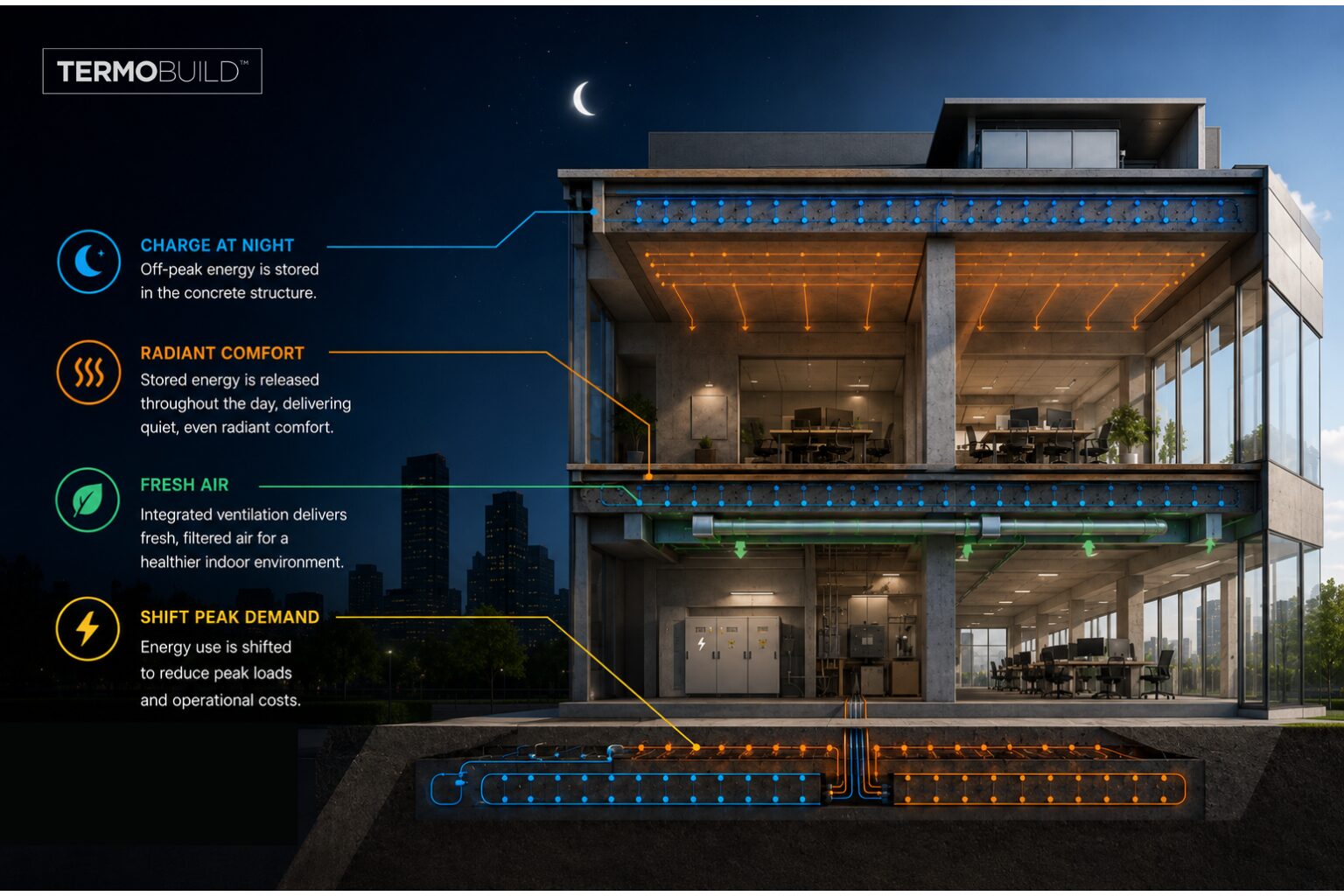
Termobuild activates the concrete structure as distributed thermal energy storage — charging during off-peak periods, releasing stable radiant comfort, supporting fresh air delivery, and reducing peak mechanical demand.
Building performance is becoming an infrastructure problem.
Electrification, cooling demand, peak demand charges, grid constraints, ventilation requirements, and resilience expectations are all converging. The question is no longer only how efficiently a building runs. It is how intelligently the building manages demand over time.
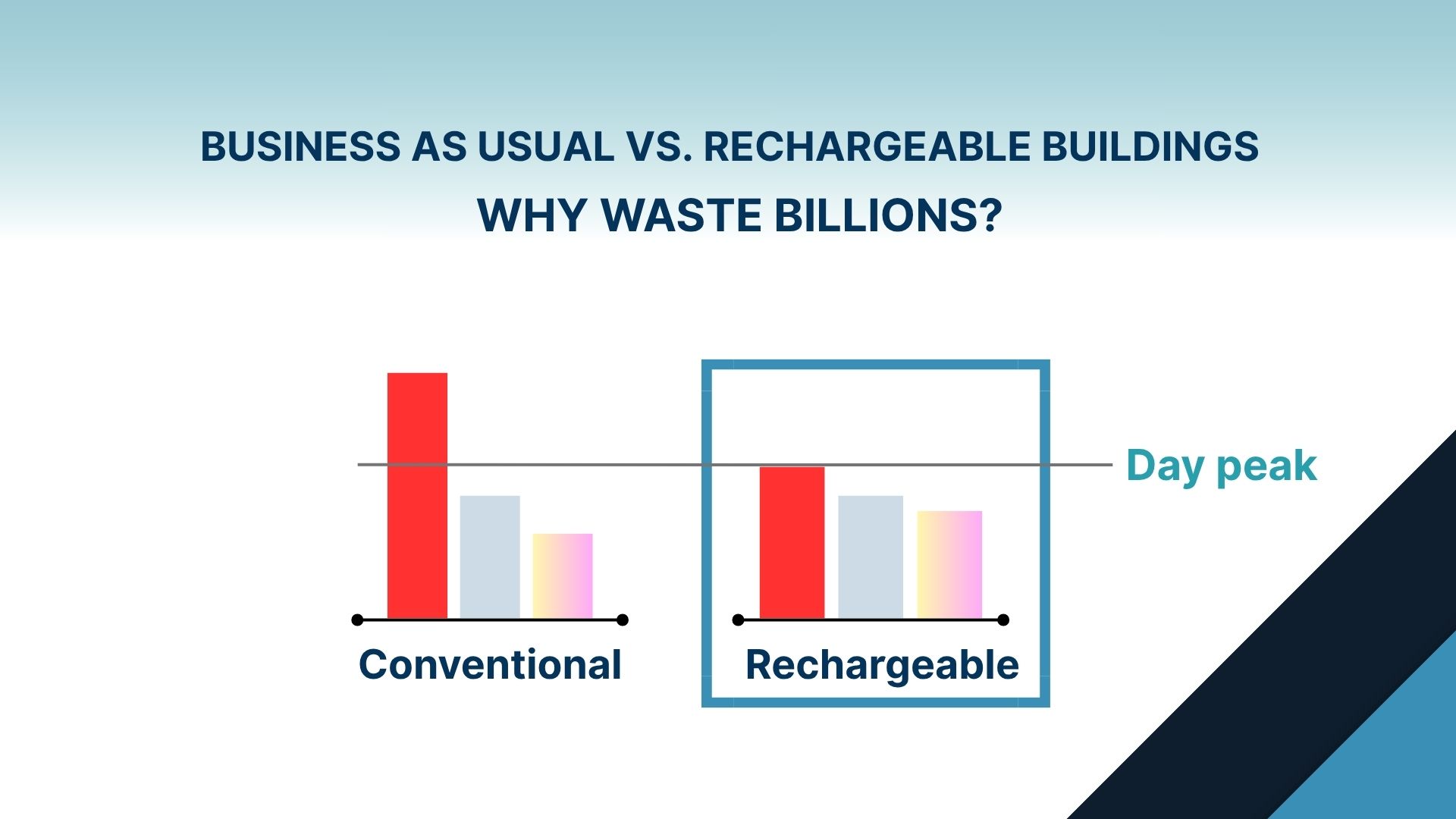
Peak demand is driving cost.
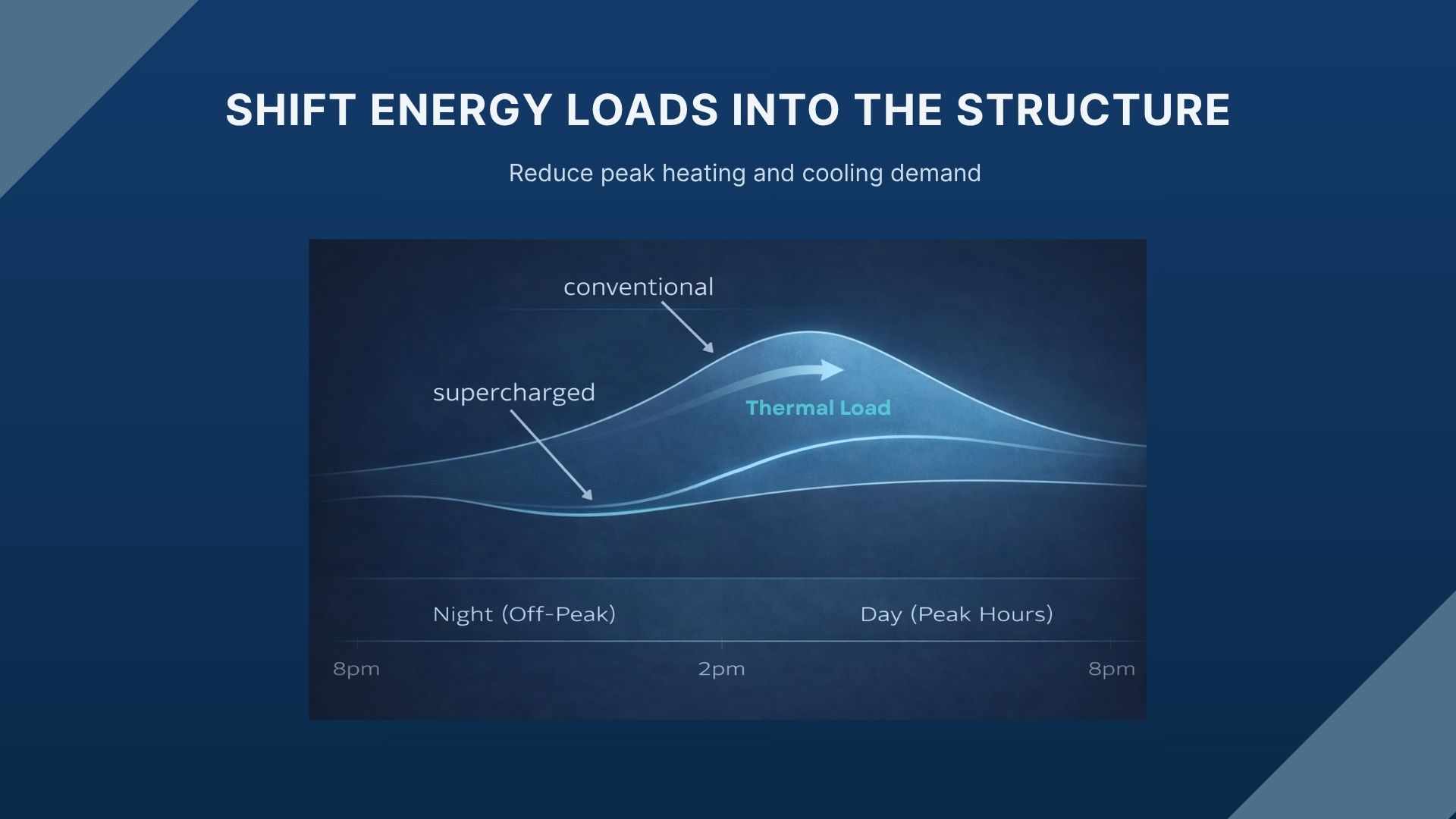
Mechanical, electrical, and utility infrastructure are often sized around short-duration peak conditions — even if those peaks occur for only a fraction of the year.
Electrification raises the stakes.
Heat pumps, cooling growth, EV charging, data centers, and renewable variability all increase the value of flexible building loads.
Software alone cannot fix inflexible buildings.
Controls are valuable, but demand flexibility is stronger when the building itself has physical thermal storage capacity designed into the asset.
Rechargeable Buildings turn the structure into active thermal infrastructure.
Conventional buildings treat concrete as structure only. Termobuild uses that same structural mass as an active thermal asset. The building can be charged during off-peak conditions and then release stored energy gradually throughout the day.
Rechargeable Buildings actively manage thermal storage.
Passive mass is incidental. Active structural thermal storage is designed, charged, controlled, and integrated with ventilation and mechanical strategy.
Passive thermal mass
- Responds to conditions after they happen
- Depends on incidental exposure and building behavior
- May help stabilize swings, but is not a full energy strategy
- Often overlooked during mechanical sizing decisions
Active structural thermal storage
- Charges the structure intentionally during favorable periods
- Uses concrete as distributed thermal storage
- Supports predictable load shifting and comfort stability
- Can reduce dependence on peak mechanical capacity
The technology behind the outcomes.
Rechargeable Buildings are made possible through engineering integration, predictive controls, proprietary energy modeling, and patented methodologies developed through real-world projects.
Explore the Technology Behind Rechargeable Buildings →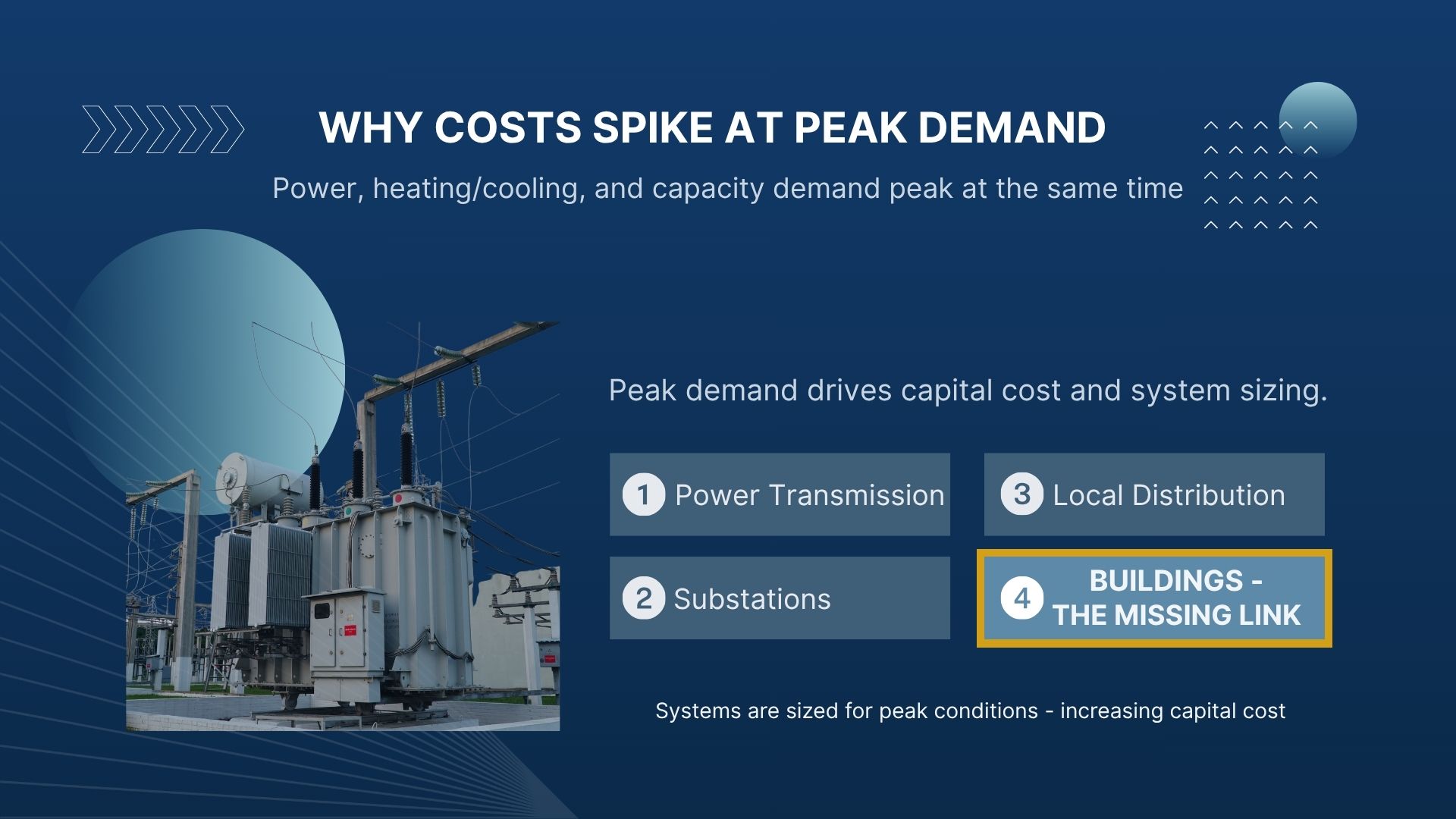
Rechargeable Buildings may be the missing link in peak demand strategy.
Much of the grid conversation focuses on generation, transmission, substations, batteries, and controls. But buildings themselves create a large share of local peak demand. If they remain thermally inflexible, the infrastructure burden continues moving upstream.
By shifting heating and cooling demand into the structure, buildings can become more grid-supportive without relying solely on batteries, ice storage, or demand-response software layered on after the fact.
For owners and capital project teams, this raises a broader question about how building infrastructure should be evaluated before conventional mechanical scope is finalized. Explore the ownership perspective.
Move value from mechanical complexity into the structure already being built.
The goal is not to add another system. The goal is to let the building’s required structure carry more of the performance burden.
Rechargeable Buildings can reduce what a project needs to build.
Instead of adding dedicated storage tanks, ice systems, or larger mechanical rooms, Termobuild uses the building mass already required by the project.
No dedicated thermal storage tanks
Storage is distributed through the concrete structure.
No ice storage system
Load shifting is achieved through structural mass, not separate ice infrastructure.
No major equipment room penalty
The value is embedded in the building system rather than added as another plant.
No new construction trade stack
The approach integrates with familiar concrete building workflows.
Where Rechargeable Buildings create the greatest value.
The strategy is strongest where comfort, fresh air, electrification, resilience, and long-term operating cost all matter at the same time.
A better building does not only consume energy. It manages energy.
A rechargeable building uses time as a design variable. It stores thermal energy when conditions are favorable and releases it when the grid, building, and occupants need it most.
This turns the structure into a long-life performance asset — not just a sunk construction cost.
Explore how rechargeable buildings store, shift, and deliver thermal energy using the structure already being built.
Authority comes from performance, not theory.
Termobuild’s positioning should connect the category-level idea back to documented projects, cost studies, and field performance.
For project teams
Termobuild creates a practical path to higher-performance buildings without forcing owners into more equipment, more coordination, and more failure points.
- Lower mechanical intensity
- Improved comfort stability
- Better fresh air strategy
- Reduced peak loads before systems are sized
For utilities, campuses, and districts
At scale, distributed structural thermal storage can support demand flexibility, electrification readiness, and infrastructure deferral strategies.
- Aggregate peak demand reduction
- Grid-interactive building operation
- Demand response and VPP compatibility
- Resilient cooling and community-scale applicability
What could your project avoid building?
If mechanical cost, peak demand, electrification, comfort, ventilation, or resilience are becoming design constraints, Termobuild can help pressure-test whether the structure can carry more of the energy strategy.