The Grid Is Becoming The Constraint.
The Structure Can Help.
Structural thermal energy storage helps data centers shift cooling load across time using the concrete structure already required in the building — reducing peak demand pressure as compute density climbs.
In most facilities, power, cooling, and compute all peak at the same time.
That concurrency is what increasingly turns grid access into the binding constraint for AI infrastructure growth.
As compute density rises, cooling intensity rises with it. Facilities are forced to build for simultaneous peaks across power, thermal load, and compute demand — increasing infrastructure pressure even before capacity is fully utilized.

Not a replacement for liquid cooling.
A parallel infrastructure strategy.
Rack-level liquid cooling remains critical for high-density compute environments. Termobuild does not replace that layer.
Instead, structural thermal energy storage works in parallel at the building level — helping shift cooling load across time and reducing the intensity of concurrent peak demand.
- Supports lower peak cooling intensity
- Helps smooth facility thermal demand
- Reduces dependence on simultaneous peaks
- Works alongside liquid-first architectures
The building itself becomes part of the thermal strategy.
Every concrete floor slab already has thermal mass. Structural thermal energy storage activates that mass intentionally — allowing the structure to absorb, store, and release energy over time instead of relying entirely on reactive cooling operation.
The battery is the building.
Conventional HVAC ductwork connects to cast-in-place or precast slab systems, allowing the structure itself to participate in heating, cooling, and thermal load shifting.
The result is distributed structural thermal storage integrated directly into the facility — without dedicated tanks, centralized ice systems, or additional thermal storage infrastructure.
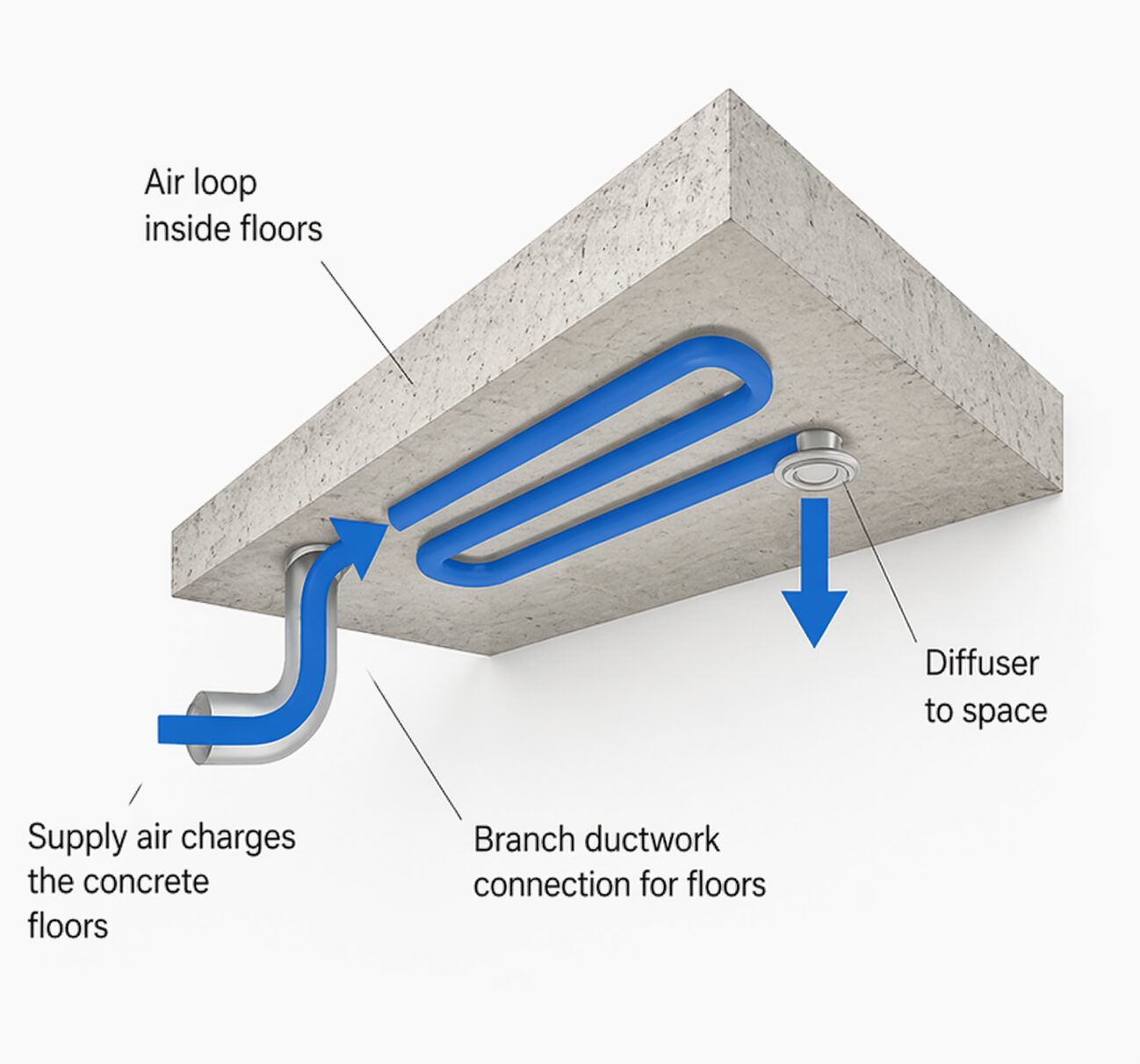
Integrated into the structure already required for the facility.
- No dedicated storage tanks
- No separate storage plant
- No short-life storage medium
- No additional infrastructure layer
Cool nights become part of the infrastructure strategy.
Structural thermal energy storage allows facilities to shift part of their thermal charging cycle into nighttime periods when outdoor temperatures and energy pricing are often more favorable.
What used to be environmental variability becomes a repeatable operational advantage built directly into the structure itself.
Peak cooling load consumes usable electrical capacity.
Cooling systems can represent a major portion of total facility power demand. By shifting part of that thermal load off peak, structural thermal energy storage can help operators recover usable electrical capacity otherwise consumed during concurrent cooling peaks.
More compute can potentially be supported without proportionally increasing peak infrastructure burden.
AI infrastructure growth is becoming a power access problem.
Data center operators are increasingly competing for constrained grid capacity while compute demand continues accelerating.
Structural thermal energy storage introduces another infrastructure lever: reducing concurrent thermal peaks by activating structural mass already required in the project.
This is not only about energy efficiency. It is about improving how facilities manage thermal load over time.
The grid is not getting easier.
Your building should be working harder.
Talk to Termobuild about how structural thermal energy storage may support peak demand reduction, thermal load shifting, and long-term infrastructure strategy for next-generation data center projects.
Explore Data Center Applications