Better building economics starts with the structure.
The building strategy approved today will define capital cost, mechanical complexity, energy demand, maintenance exposure, and operating burden for decades.
Before committing to larger mechanical systems and layered infrastructure, evaluate what the structure itself can do.
Termobuild activates concrete floor and ceiling systems to store and release heating and cooling energy over time — reducing the amount of mechanical infrastructure the building depends on.
Most building decisions become long-term ownership decisions.
Mechanical systems, plant space, operating cost, maintenance exposure, occupant comfort, and resilience are often shaped early — before owners fully evaluate alternative infrastructure strategies.
Financial advantage starts before the building opens.
Termobuild can improve project economics by reducing the amount of mechanical infrastructure required to deliver high-performance comfort, ventilation, and thermal stability.
Lower hard-cost pressure
By using the concrete structure to store and release energy, project teams may reduce oversized HVAC capacity, ductwork intensity, ceiling plenum requirements, and other mechanical-system burdens.
Fewer systems to coordinate
Simplified infrastructure can reduce interface points between trades, helping lower the risk of design clashes, redesign, rework, and unnecessary mechanical complexity.
Better cash-flow profile
Smaller mechanical scope can reduce the size and timing of certain equipment deposits, subcontractor mobilization costs, and upfront material commitments.
Lower indirect-cost exposure
When systems are simplified and coordination improves, teams may reduce the time, overhead, and general conditions associated with mechanical complexity.
Reactive buildings create different financial outcomes than rechargeable buildings.
Conventional buildings often respond to thermal loads after they occur. Termobuild changes that relationship by allowing the structure itself to store, release, and stabilize heating and cooling energy over time.
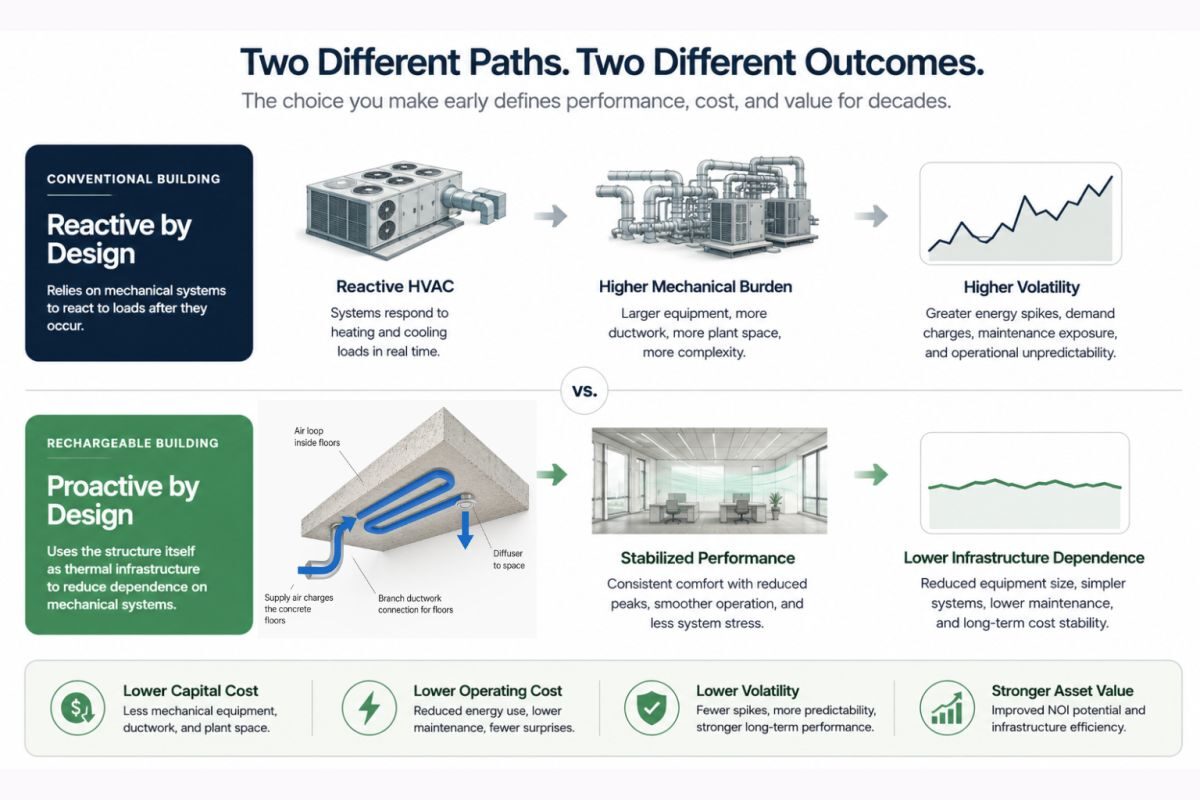
High-performance buildings do not always need more infrastructure.
Many projects pursue performance goals by layering additional systems, controls, and thermal infrastructure onto buildings that remain thermally passive. Termobuild approaches performance differently by allowing the structure itself to participate in thermal load management.
Better building performance may come from using the structure more intelligently — not simply adding more systems.
Termobuild shifts part of the building’s energy strategy from added mechanical infrastructure into the structure itself, reducing dependence on separate systems while stabilizing comfort and operational performance.
Peak heating and cooling demand
Added thermal infrastructure layers
Embedded infrastructure lifecycle
Comfort and energy stability
Termobuild reduces the volatility created by reactive HVAC dependence.
Conventional buildings constantly react to thermal load after it occurs. This can increase peak demand, operational instability, mechanical wear, and long-term infrastructure burden.
Buildings that use the structure itself as thermal storage behave differently.
The structure stores heating or cooling when conditions and energy economics are favorable.
Thermal energy is released through the day to help maintain consistent indoor comfort.
Peak mechanical demand can be reduced because the structure is doing part of the work.
Lower operating costs and lower volatility can improve long-term asset performance.
The goal is not only to reduce energy use. The goal is to create buildings with stronger economics, more predictable operation, and better long-term value.
A school project illustrates the financial opportunity.
In a South Carolina K–12 campus analysis, integrating structural thermal energy storage into the building strategy created opportunities to reduce mechanical requirements and overall project capital costs. The value was not limited to the energy bill.
About these figures: The 9.7% figure refers to the project-level capital-cost comparison, not a 9.7% HVAC-only saving. It is presented as a project analysis, not a universal or guaranteed result. Confirm the final project area, analysis methodology, and supporting documentation before publication.
Financial questions worth asking before design is finalized.
Can building design reduce upfront HVAC and construction costs?
Potentially. When a building's structure actively stores and releases heating or cooling energy, engineers can evaluate lower peak mechanical requirements and less supporting infrastructure. The South Carolina school analysis demonstrates why this comparison belongs early in project planning.
Can lower operating costs also improve long-term project returns?
They can, depending on the project's financing, ownership horizon, utility tariffs, and maintenance requirements. The relevant decision is the combined effect of upfront capital, annual operating expense, and long-term replacement exposure—not energy savings in isolation.
How do we determine whether these savings apply to our building?
Compare a conventional design with a Termobuild-integrated alternative using project-specific heating and cooling loads, equipment sizing, infrastructure quantities, energy modeling, and lifecycle cost assumptions. Explore the project evaluation approach →
Understand the financial impact before major infrastructure decisions are finalized.
Termobuild helps project teams evaluate where structural thermal energy storage may reduce mechanical burden, lower operating costs, improve comfort, and strengthen long-term asset performance.
Evaluate before systems are oversized, specified, or locked in.
- Mechanical infrastructure requirements
- Peak demand and energy strategy
- Operating cost and maintenance exposure
- Long-term comfort and resilience goals